• 4Rs Tips for 6.3.2022 – Composting and Gardening: Great Habits and Hobbies

    June 3, 2022
    sustainability

    4Rs Tips for 6.3.2022 – Composting and Gardening: Great Habits and Hobbies

    New Ways to Compost Make It An Easy, Planet-Friendly Habit to Adopt

    I used to think of composting as a difficult and messy activity that only worked for people who own a home with a big yard where a smelly compost bin can be placed far away from the house. Maybe that was true once, but not anymore.

    Composting is the ultimate reuse and it’s easier than you may think

    Photo by Sarah Chai on Pexels.com

    Composting is an easy individual choice we can make to do our part for the planet. And, we have tons of tools available to help us do it. 

    The coolest invention I’ve seen lately is these indoor countertop composting machines. These systems have charcoal filters that help control odors and convert your food scraps into dirt overnight. It’s pretty cool. 

    • The Lomi, by Pela is a one-step composting system that makes it easy to reuse your food waste and save money. Check out this 2-minute video to learn more. Cost $499
    • The Vitamix FoodCycler FC-50 is another indoor composting system I found. One article praised it as doing a remarkable job of reducing one’s waste footprint. Cost $399

    You don’t need a garden to use compost, these machines make clean dirt you can use in any plants, indoor or outdoor. So you can compost even if you live in a high-rise apartment in a big city. 

    There is the consideration that this is yet another electric appliance you run in your home that adds to your energy use. But, emissions from food rotting in landfills or being incinerated are one of the biggest environmental issues we face.

    A less expensive way to do indoor composting is by using a composting bin. These usually contain a charcoal odor control system and are meant to be storage for your food waste until you can transfer it to your municipal pick-up bin. If you do have curbside composting, check with your service to find out what they take and, if they take food scraps, consider getting one of these bins for your kitchen to make your composting process a bit easier.

    No matter what method you choose, there are lots of solutions offered online, so do your research to find the one that’s right for you. A good beginning is to read reviews, like this one on composting bins and methods from Good Housekeeping.

    Composting is circular and regenerative

    Food waste is a major issue and we have control over it. Better meal planning and grocery shopping strategies help, but that doesn’t eliminate all food waste. We still have to deal with orange peels, egg shells, coffee grounds, and other organic waste we generate.

    Regenerative Gardening is Simple and Could Save Us All

    I talked about reusing plastics to decorate gardens in my last post, but more important is building Climate Victory Gardens. The type of gardening that is regenerative and helps the soil heal. The kind that, if everyone started doing it, can more quickly reverse climate change. 

    • This Green America video gives the 6 steps to regenerative gardening.
    • Once you’re practicing regenerative gardening, order yourself a Climate Victory Garden sign, made from recycled aluminum. It’s a $10 donation. Check it out, it’s cute.
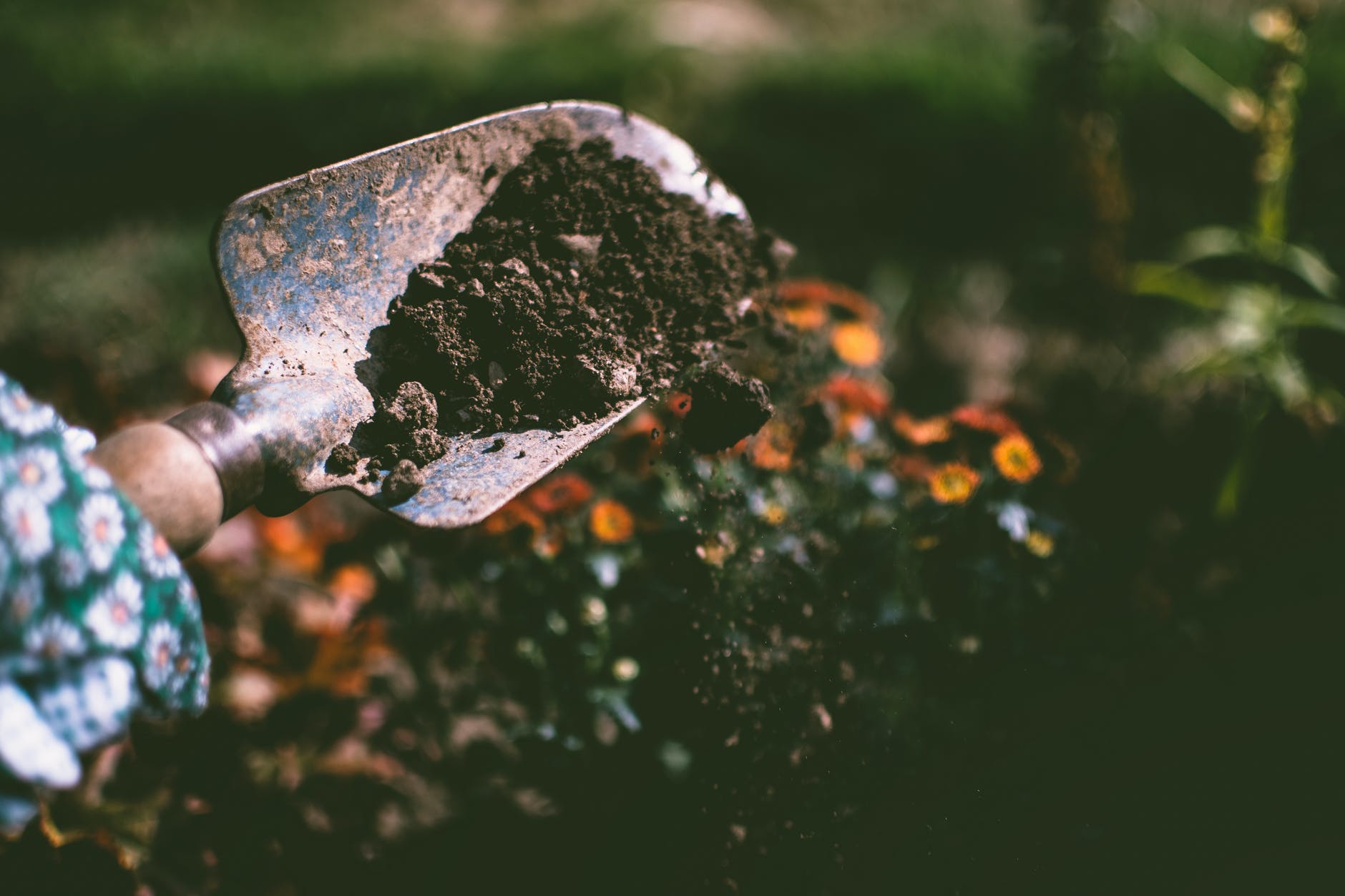
    Photo by Lisa Fotios on Pexels.com

    Let’s stop food waste by reusing it to add value to our lives and save the planet

    Composting is the best way to eliminate the wasted food that we generate each day. And there are so many benefits.

    • Compost is the best organic fertilizer for your plants and garden.
    • Save money and the planet by eliminating chemical fertilizers.
    • You will spend less on dirt for your planters.
    • Composting is one of the 6 steps to regenerative gardening.

    If you’re really into learning all you can about composting and want some DIY tips, this article from Earth Easy covers details on how to make and maintain your own compost system.

    Find More Reuses for Your Food Waste

    Another way to reduce your food waste is to reuse it. Here are some great ideas you might want to try.

    • Coffee grounds make a great odor absorber – Most people I know put baking soda in their frig to absorb odors. I know I used to. But that wears out and you have to buy more to replace it. Save money and use the coffee grounds you’ve already bought. With food prices going up, it helps to get maximum use out of those expensive coffee grounds.
      • Reuse a plastic tub, like cottage cheese, and dump used coffee grounds in it once they’ve cooled. Place it in the back of your frig to absorb food odors. 
      • Keep adding to it as you make coffee
      • Stir it with a spoon to increase absorbency and,
      • Scoop some out on cleaning day to use as an abrasive. Mixed with dish soap it’s a great way to get stubborn burns out of a pan or stains out of a dish.
    • This article gives 11 Tips To Reuse Food Remains In The Household and has a cool recipe for making potato chips out of the skins when you peel them.
    • Or these tips on Clever Ways to Use Inedible Food Scraps Around the House.

    There are so many great ideas out there. Put how to reuse food scraps in your Ecosia search engine to find lots of great ideas.

    Why It’s Important

    A recent article from the US Department of Agriculture, Food Waste and its Links to Greenhouse Gases and Climate Change, states that “food waste is the single most common material landfilled and incinerated in the U.S.”

    What sucks is, that it’s preventable. If we make a conscious effort to reduce our food waste – composting is just one of the ways – we could take a huge bite out of human-influenced climate change.

    Ways You Can Make A Difference This Year

    It’s not taboo to talk climate. 

    Share this video which might open someone’s eyes to the impact of humans on our planet. Three Seconds was the Film4Climate short film winner in 2016. Give it a watch. It’s only 4 minutes long and well worth your time.

    Do you like surveys and quizzes? Try some of these EarthDay.org quizzes to test your Climate Change knowledge.

    With Much Gratitude

    That’s it for this week. If you like this post, please forward it to every earth-friendly human you know. 

    I hope, with your help, to make it to the Climate Reality Project leadership training in Las Vegas this June and learn more about how to fight for our planet. Please share this post and visit my GoFundMe page to help me get there.

    Drop me a line anytime if you have questions or comments. I love hearing from you.

    Thank you for reading these tips and subscribing. Pat yourself on the back for doing your part. Remember, every little bit helps.

    You got this!

    Jen
    jen.thilman@gmail.com 

    Sign-up to receive these weekly 4Rs posts

    By clicking submit you agree to share your email address with the site owner and Mailchimp to receive marketing, updates, and other emails from the site owner. Use the unsubscribe link in those emails to opt out at any time.

    Processing…
    Success! You're on the list.
    Whoops! There was an error and we couldn't process your subscription. Please reload the page and try again.
    1 comment on 4Rs Tips for 6.3.2022 – Composting and Gardening: Great Habits and Hobbies
  • 4Rs Tips for 5.27.2022 – Fight Consumerism: Reuse What We Have to Save the Planet

    May 27, 2022
    sustainability

    4Rs Tips for 5.27.2022 – Fight Consumerism: Reuse What We Have to Save the Planet

    First, A Moment of Reflection

    After the horrific murders of innocent children and their teachers this week in Texas, I can only hope that somehow we can begin to listen more and learn how to live together. To live in harmony with all life around us, with each other and Mother Earth.

    Reducing How Much We Use and Eliminating Waste is Critical

    To reduce our impact on the planet we need to reduce consumption. I ran across an article this week addressing the question, Are clothes made from recycled materials really more sustainable? and a quote at the end stuck with me. It said, 

    “We’ve been trained to see ourselves primarily as consumers … that the way we solve these problems is by buying, which is the antithesis to the real solution.”

    Photo by Anastasia Shuraeva on Pexels.com

    We’ve been so programmed to believe this our brains find pleasure in obtaining more stuff. So it’s easy to buy into the idea that consuming more will solve all our problems when there is nothing further from the truth. Our greatest weapon against this programming is to find pleasure in creating useful stuff with what we already have. 

    Personally, I find a lot more pleasure in creating new stuff out of old than I do from buying new. But that wasn’t always the case. It took time for me to change my mindset, and if I can do it anyone can.

    Creative Ways to Reuse Everyday Items and Give Them New Life

    I’ve run across some ingenious reuse ideas online and wanted to share some with you. From using bottles and containers to make an item you would normally buy, to ways to reduce impact in your own backyard.

    For gardening and landscaping try these reuse ideas.

    With humans using 1.2 million plastic bottles per minute, we’ve got to start using the heck out of these materials so they don’t keep piling up on our planet. Yes, we need to avoid buying them to slow down production, and buying beverages in cans will make a big difference, but so much has already been made and it’s not going away, so we have to reuse it. Gardens and landscapes are a great place to start.

    • Drainage for your planters and canister gardening. Put any plastic container with the lid on at the bottom of your planter before adding dirt. This helps with drainage, and with moving your planters since plastics are so lightweight.
    • Make landscaping bricks and designs out of plastics. Recycled plastics are so durable they are now being used in construction. Check out these tips on how to use single-use plastics and turn them into a beautiful part of your landscaping.
      • I love these planter ideas: 15 Creative DIY Recycled Plastic Bottle Garden Ideas, or this 25 Plastic Bottle Vertical Garden Ideas | Soda Bottle Garden. 

    I mean, why would you ever go out and buy a planter when you likely have a lot of plastics in your home that could make one that uniquely expresses you.

    • If you’re the creative type and want to be inspired by some great ideas, check out this video with 90 Beautiful Garden ideas Using Old Plastic Bottles.
    • I love this idea – How to Build a Greenhouse Using Plastic Bottles.
    • Here’s a DIY to make plastic bricks at home.
    • If you’re really into it, here are 103 DIY Plastic Bottle Ideas for Garden & Home.
    • And don’t miss out on these 10 Clever Hacks for Reusing Plastic Bottles in the Garden. There are some cool ideas on that page.
    • Recycled yard and garden art are unique and fun, especially if you are reusing something that doesn’t work anymore.
      • I love that there are over 900 recycled garden art ideas on Pinterest. 
      • Or, check out Crazy Cool Garden Art Ideas From Junk!
      • And, if you really aren’t into making crafts, buy recycled art for your yard or garden instead of new. There are over 5,000 items for sale under recycled yard art on Etsy.
    • Boost your food growing by reusing what you have around the house. 
      • Check out this brilliant video of great ideas: 17 Brilliant FREE Vegetable Gardening Hacks | More Food for Less Effort.
      • Learn how to harvest new seeds for the next growing season at How to Save Seeds.

    Clothing and other textiles are everywhere and have so many reuses.

    If clothes are in good condition you might want to donate them or sell them, but if you usually wear them until they aren’t wearable anymore why not make use of that material another way.

    • You can collect old t-shirts and make a braided rug with them.
    • Cut old clothes up into rags for cleaning or check out this DIY way to make a duster.
    • When the material is worn thin, cut it into pieces to make a strainer.
    • Attach a small piece of material with a rubber band to a wide-mouth plastic bottle. Use a needle to poke holes in the cloth to make a watering can for your plants. Cut a hole in the neck or side of the bottle to make it easier to refill.
    • Make a two-person game called Mancala with buttons off old shirts and an egg carton.

    I found some really great ways to reuse and recycle many household items in this article by Green Child Magazine, and in this article 100 Ways to Repurpose and Reuse Broken Household Items.

    We Need to Pressure Big Business to Do Their Part and Reduce Impact

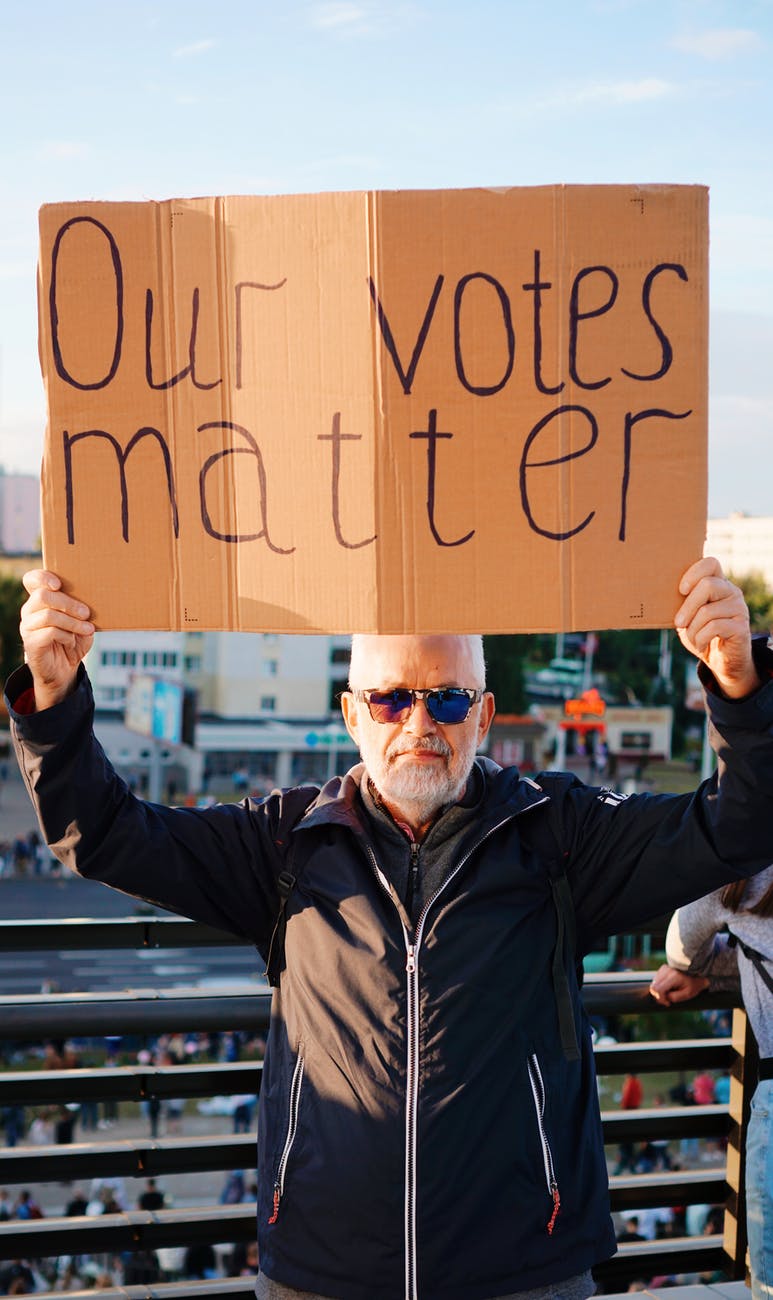
    It’s election time in many states in the US so I want to remind you to vote. But don’t just vote, do some research ahead of time to make sure you vote for people who love our planet. If we elect environmentally conscious politicians we will finally be able to force corporate polluters into doing their part to reduce and reuse, like with ERP laws that require them to take responsibility for packaging and what happens to it. It shouldn’t all be on us consumers to deal with the waste.

    We have leverage over corporate polluters
    with our dollars and our votes

    Photo by Pixabay on Pexels.com

    Why It’s Important

    Nothing is more important right now than working to reduce our impact on the planet. Humans have spent generations living in ways that go against nature. We didn’t know any better, but now we do.

    Finding ways to reuse stuff generally means taking on a project, whether big or small, but it also means opportunities to make something with your kids, friends, or family. It means bonding time and developing connections. And isn’t that what we really need to build a world where mass shootings no longer happen?

    I saw a great video the other day that I feel really sums up the situation we’re in. It’s called Three Seconds and was the Film4Climate short film winner in 2016. Give it a watch. It’s only 4 minutes long and well worth your time.

    Ways You Can Make A Difference This Year

    It’s not taboo to talk climate. 

    Find out how to have climate conversations. Learn the facts to weed through climate disinformation and help others learn. I recently learned about a fun way to do that with a game called Cranky Uncle. Check it out and start your knowledge journey about climate change.

    Do you like surveys and quizzes? Try some of these EarthDay.org quizzes to test your Climate Change knowledge.

    With Much Gratitude

    That’s it for this week. If you like this post, please forward it to every earth-friendly human you know. 

    I hope, with your help, to make it to the Climate Reality Project leadership training in Las Vegas this June and learn more about how to fight for our planet. Please share this post and visit my GoFundMe page to help me get there.

    Drop me a line anytime if you have questions or comments. I love hearing from you.

    Thank you for reading these tips and subscribing. Pat yourself on the back for doing your part. Remember, every little bit helps.

    You got this!

    Jen
    jen.thilman@gmail.com 
    Sign-up to receive these weekly 4Rs posts

    By clicking submit you agree to share your email address with the site owner and Mailchimp to receive marketing, updates, and other emails from the site owner. Use the unsubscribe link in those emails to opt out at any time.

    Processing…
    Success! You're on the list.
    Whoops! There was an error and we couldn't process your subscription. Please reload the page and try again.
    No comments on 4Rs Tips for 5.27.2022 – Fight Consumerism: Reuse What We Have to Save the Planet
  • 4Rs Tips for 5.20.2022 – Help Kids Understand Climate Change

    May 20, 2022
    sustainability

    4Rs Tips for 5.20.2022 – Help Kids Understand Climate Change and Why It’s Important

    But First… An Ask

    My application has been accepted to attend the Climate Reality Project leadership training in Las Vegas, June 10th – 13th, 2022. Yay! 

    Now I need to come up with the funds to attend. While I have airline credits (I know, not a sustainable way to travel but I will fly non-stop to reduce emissions), I don’t have the funds for hotel, meals, and ground transportation. I have started a GoFundMe page to ask for donations. Any amount will help me reach my goal and go to the training. Thank you!

    Educating Kids is Our First Defense to a Cleaner Future

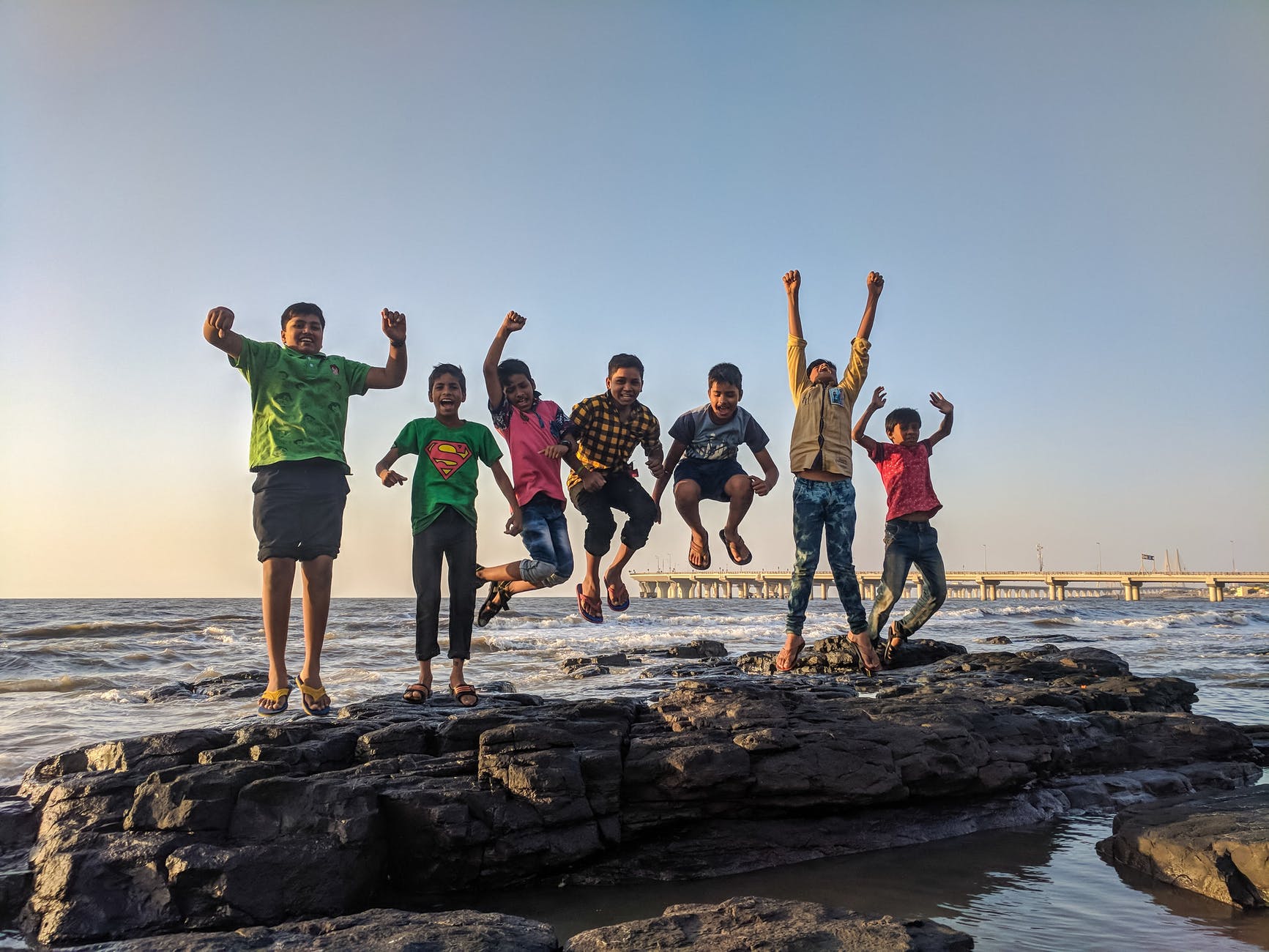
    Let’s admit it, for the most part, people in developed countries live pretty comfortably. We have a lot of conveniences. These habits create a lot of waste and we accidentally teach our children these habits because, honestly, we learned them from our parents. Our children will build good habits if we do. Be open to learning alongside them and teach them that by working together we can make this a better world.

    If we want our kids to build planet-friendly habits
    we have to show them how

    Photo by Guduru Ajay bhargav on Pexels.com

    Click here if you’re new to this blog and want to know what it’s all about.

    If you have young children 7 and under… they are hungry to learn and easy to teach. 

    • Find fun activities that teach kids at a young age that we are all part of the living planet and we need to learn to live in harmony with the earth.
      • To get started with some basics, check out Fun Activities to Teach Your Kids Sustainability This Summer.
    • Have them carry reusable food containers for lunch and to events. 
      • Let them pick a cool lunch pail they will like and use.
      • Tell them this is a great way for them to control waste and fight climate change.
      • The best part, remembering to bring home their lunch pail or food containers is the first step in learning responsibility. (Yes, they’re growing up now.)
    • Talk to them about why you do eco-friendly things in the home, like turning out lights, unplugging unused appliances and chargers, and switching to energy-efficient light bulbs and appliances. If you can’t answer their questions as to why we need to do this, look it up with them. It’s a fun family learning activity.
    • Have them come up with ideas on ways to save water and energy in your home.

    It boils down to us being responsible for the planet and teaching kids at a young age how to do the same.

    Kids age 7 and up… begin to read on their own and have started to learn about the climate crisis. Instead of letting them get freaked out on their own, wouldn’t it be good to talk with them about their feelings and empower them to understand and act on those feelings?

    • Talk to your kids. They’ve likely learned about climate change in school. Ask them about what they’ve learned. Asking questions is the best way to engage our children and gauge what they think and feel. 
    • Ask your kid’s school if they have recycling and if they teach kids how to do it.
      • Help your school build a recycling program and teach the 3Rs to students. The US EPA has this guide: Reduce, Reuse, Recycle Resources for Students and Educators. Share it with educators and other parents. Start small, think big.
      • Encourage your kids to work with you to support or launch environmental programs in their schools.
    • Check out this resource of easy experiments and climate lessons: 15 Meaningful and Hands-On Climate Change Activities For Kids: How to teach about our changing planet.
    • MAKE IT FUN! Kids don’t want to work, they want to play. Use that to help them learn about caring for Mother Earth.
      • Check out Captain Polo – a series of graphic novels about an adventurous polar bear who travels the world learning about climate change and what we can do about it. Your kids will love him. There’s also a Captain Polo board game: The Official Captain Polo Climate Change Board Game. The author, Alan J. Hesse, has a YouTube channel where you can find more resources.
      • NASA has this fun Climate Kids page that can help young kids understand climate change.
      • The Climate Institute provides a Climate Games page with a variety of activities for kids of all ages.
      • Turn older kids onto climate video games. Check out this article: Leveling Up: How Video Games Are Inspiring A New Wave of Activism.
    • Have them go with you to the website of your recycling service and review the acceptable items that go in your recycling bin. You’ll likely learn something, too.

    Encourage your kids to be part of the change needed. Young people are full of ideas and innovations. Share this story with your kids on how Young Innovators Challenge The Future.

    Connect Kids With Nature So They Learn to Appreciate Mother Earth

    Learning to appreciate Mother Earth, how cool she is, and all the beauty she provides will teach our kids to care for her. Set aside time to connect you, your kids, and the earth. If you don’t have access to a nature park or forest, find online options for learning about nature and the other creatures that live on the planet.

    • Teach kids about sea life so they learn to appreciate how important they are to our lives. This cool. May 20th is Endangered Species Day. Take and share this fun quiz to learn all about endangered species. It’s short, five-question, and very educational. 
    • Plan nature days with your kids. Look up the website of a local nature park or national forest. I’ve never seen one that doesn’t have a kid page. These are usually loaded with things you and your kids can learn about the natural area and its inhabitants.
    • Look for tree planting opportunities in your community.
    • Encourage them to garden with you. If you have a garden project, I’m sure you will appreciate the help and your kids could learn a lot.

    Climate Anxiety is a Real Thing for Our Youth

    As our youth get into their teen years they start to see the world and the realities of climate change. 

    A recent study involving 10,000 young people age 16-25 found that 75% fear the future due to climate change, and almost half reported climate anxiety affected their daily lives. I read that over half of young adults are reluctant to have children considering what the future holds for life on this planet. That’s not good.

    The young people of our world know what the next decade will bring and they’re fighting to keep it from being as bad as scientist have told us it will be if we keep doing what we’re doing.

    Encourage your teens to find an organization they want to get involved with and be part of the change we all know we need. 

    • The Sunrise Movement is a youth run activist organization fighting corporations and the fossil fuel industry.
    • Earth Uprising is an organization of youth activist helping us stay informed and fighting for climate justice.
    • Get social with your kids – there are so many resources for you and your kids to learn and get engaged on climate. 
      • Follow Inconvenient Youth on InstaGram
      • Have them look up some of these orginazation on their favorites socials.
    • Watch documentaries on climate change with them.
      • I recently watch Youth V Gov on Netflix. It was inspiring and sad. I was excited to see the extent that young people are going to save their future. They have the vision we all need.
      • Watch An Inconvenient Truth with you teenagers. I’m just saying.

    In my post on April 8th about Climate Overwhelm, I talked about our best defense when climate anxiety sets in is to take action. This applies to our kids, too.

    Why It’s Important – Their Future Depends On It

    Duh!

    Our kids are smart. Keep them involved in climate friendly activities and environmental programs. They’ll thank you for it one day.

    Help kids feel better prepared for the future. Help them imagine that things can get better, not worse. This can only happen through action.

    Ways You Can Make A Difference This Year

    Check out these 52 ways to celebrate our earth and make a difference from Earth Day.org

    Do something fun this spring, sign-up for a  Clean-Up Event. They’re not just for Earth Day! Check the map and search by the dates you have available. Then save the link and look for ongoing ways to help clean up your community. You may find a local organization you want to join and support.

    Do you like surveys and quizzes? Try some of these EarthDay.org quizzes to test your Climate Change knowledge.

    With Much Gratitude

    That’s it for this week. If you like this post, please forward it to every earth-friendly human you know. 

    I hope, with your help, to make it to Las Vegas in June and learn more about how to fight for our planet. Please share this post and visit my GoFundMe page to help me get there.

    Drop me a line anytime if you have questions or comments. I love hearing from you.

    Thank you for reading these tips and subscribing. Pat yourself on the back for doing your part. Remember, every little bit helps.

    You got this!

    Jen
    jen.thilman@gmail.com 
    Sign-up to receive these weekly 4Rs posts

    By clicking submit you agree to share your email address with the site owner and Mailchimp to receive marketing, updates, and other emails from the site owner. Use the unsubscribe link in those emails to opt out at any time.

    Processing…
    Success! You're on the list.
    Whoops! There was an error and we couldn't process your subscription. Please reload the page and try again.
    No comments on 4Rs Tips for 5.20.2022 – Help Kids Understand Climate Change
  • 4Rs Tips for 5.13.2022 – Does Recycling Work? Your Thoughts

    May 13, 2022
    sustainability

    4Rs Tips for 5.20.2022 – Does Recycling Work? Your Thoughts

    But First… An Ask

    My application has been accepted to attend the Climate Reality Project leadership training in Las Vegas, June 10th – 13th, 2022. Yay! 

    Now I need to come up with the funds to get there. While I have airline credits (I know, not a sustainable way to travel but I will fly non-stop to reduce emissions), I don’t have the funds for the hotel (over $1,000), meals, and ground transportation. The training is free. I have started a GoFundMe page to ask for donations. Any amount will help me reach my goal and go to the training. Thank you!

    And Now… For the Real Elephant in the Room

    A Burning Question and Frustration – Does Recycling Work?

    I talked about the elephant in the room when I discussed reducing waste recently, but I have to admit that the real elephant in the room is how crappy recycling is. Turns out, the first elephant was about waste reduction, because recycling doesn’t work very well. If it had been working all these years we’ve been doing it, we’d have more recycled packaging today.

    94% of Americans support recycling

    Photo by Lisa Fotios on Pexels.com

    We want to get it right but we are frustrated by inaction from corporate polluters.

    As I look at the comments from people who have taken my recycling survey (see the numbers below), I found that people are frustrated because we’ve been increasingly doing our part, but companies and big industries have not. This fits with comments I hear when I talk to people about recycling. Though this is starting to change, it’s not happening fast enough. 

    Our governments need to put pressure on manufacturers and the fossil fuel industry that makes plastics. And, we need to pressure our governments to do this.

    Without buy-in from governments and the companies making products, plastic recycling will continue to be ineffective

    What’s the point of recycling if it doesn’t work?

    Actually, it does work… for paper, cardboard, glass, and metal. In general, over half of these materials get used again because they’re pretty basic and easy to recycle. Unfortunately, that’s not true for plastics.

    Two key elements have been lacking in making our recycling successful and they revolve around plastic packaging.

    1. The infrastructure to process plastics into another usable material is minimal and the demand is low.
      • There are too many types of plastics which makes it difficult to recycle them. Only #1 and #2 are easily recycled because the process to turn them into another plastic is more common and has been around for a while.
      • Virgin plastics made from fossil fuels are cheaper than recycled, and manufacturers have no incentive to pay for more expensive recycled materials and packaging. 
    1. The companies making products, especially the packaging, need to be held accountable for it and what happens to the materials at end of use.
      • Extended Producer Responsibility (EPR) laws require manufacturers to take responsibility for how their packaging is made and what happens to it after we use it. Many countries have these and last year Maine became the first state in the US to pass an EPR law. We need more of these laws since this is a critical step toward the circularity of our waste. 
      • Demand will increase for recycled plastics when we have more EPR laws in place requiring manufacturers to take responsibility for recycling and use of them.

    If they’re forced to, corporations can and will build the recycling systems to take care of plastics.

    What should we do?
    Support local laws that promote circularity.

    It fascinates me that more people in the US vote in the national elections than in local ones when it’s the local elections that affect our lives the most. While I’m not familiar with how elections work in other countries, I am sure of one thing… if we don’t vote our elected officials don’t know what we care about. 

    I will admit, I didn’t use to vote locally very often. But my love for Mother Earth led me to understand that is how I can help protect her.

    Vote locally to impact our everyday lives and the planet

    Photo by Artem Podrez on Pexels.com

    In the US, local initiatives are what make a difference. Laws around container deposits, packaging, and toxic materials like polystyrene (commonly known as styrofoam) are being enacted due to pressure from people and grassroots efforts.

    We need more bottle deposit laws and existing ones need improving.

    Currently, 10 of the 50 states in the US have bottle deposit laws. Some are more effective than others. 

    I spent most of my life in Michigan where a Bottle Bill has been in place since 1978 that requires retailers who sell beverages to take back the containers. It works great. Grocers now have automated machines where you insert your container and get your ten-cent deposit back. I became aware that effective recycling programs like Michigan’s were uncommon when I moved to California. We have deposit laws in my new state, but it is difficult to return bottles, especially for someone like me who is disabled. 

    Bottle deposit laws are one of the most effective forms of recycling.

    • Proven effective, bottle return regulations have been around since the 1800s. 
      • It is estimated that the return rate is around 90% with bottle deposits.
      • When returned, these materials require minimal sorting and are almost guaranteed to be recycled.
    • Around 40 countries have bottle deposit laws. Some of these have yet to be enacted.

    There’s a reason laws have cropped up banning plastic shopping bags and toxic carryout containers.

    Plastic shopping bags and polystyrene containers are bad for the environment and they don’t easily recycle. These are two of our most dangerous forms of plastic waste (yes, polystyrene is plastic), which is why more communities around the globe are banning them. 

    • There are 77 countries that have passed partial or full plastic bag bans.
    • Eight states in the US now have plastic bag bans, some include polystyrene bans.
    • Thanks to grassroots efforts in the US, Colorado passed a law to ban these disposable plastics in 2021.

    Pay attention to measures and bills proposed in your local elections and stay informed so you can vote for the planet. Support candidates that act to protect our environment.

    These are things that will get recycling moving in the right direction and help us deal with our plastics problem.

    We’ve built our recycling habits and our waste isn’t going away so we have to keep trying.

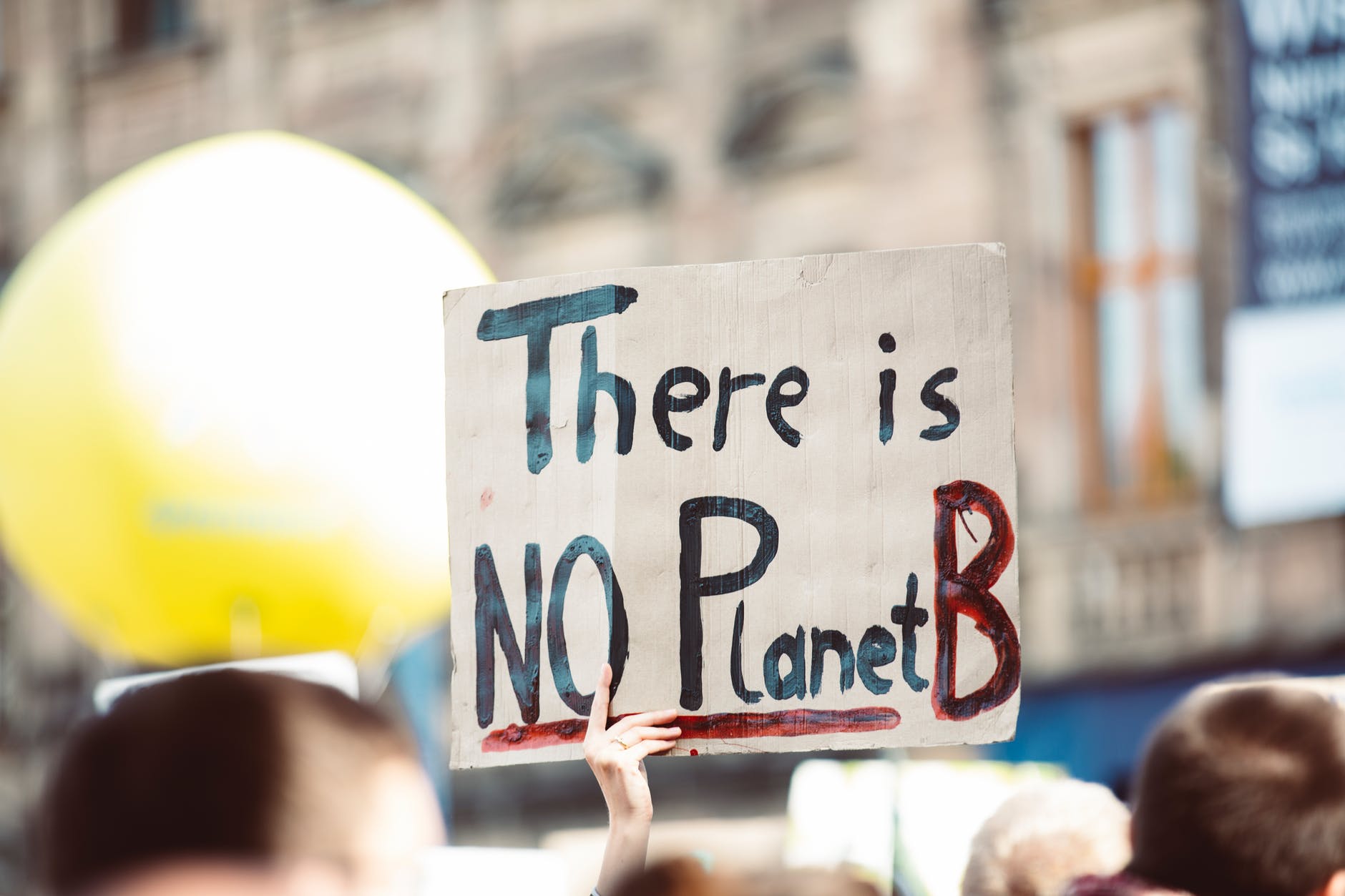
    We know recycling makes sense, but we feel helpless to make it work. But giving up is not an option. We have no Planet B, as the expression goes. 

    We have to get out in our community and push for our environmental rights. It’s the only solution. And from what I’m learning, most of us want to do something.

    And the Survey Says… 4 Months of Survey Input Reveals We Care

    When people get to know me and find out I’m kind of a recycling nut (maybe more than kind of) they often come to me with questions. How? Why? All that good stuff. 

    This inspired me to start this blog. Though it’s about more than recycling – reducing waste is my main focus – we still need to get recycling right and I want to help us do that. The best way is through understanding.

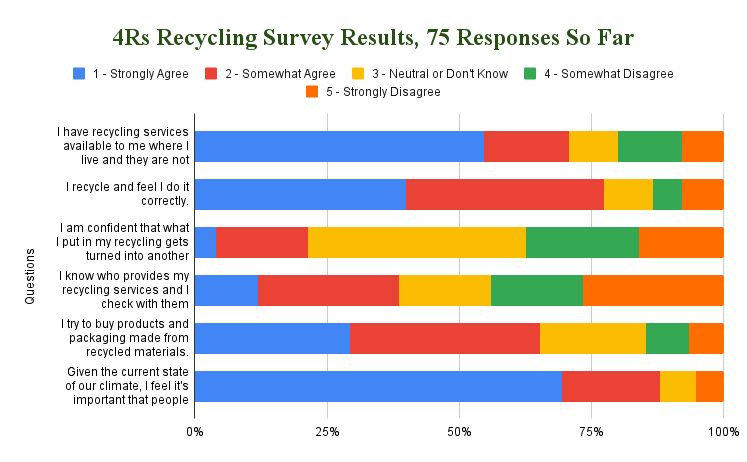
    I launched my recycling survey to accompany the blog in order to understand people’s thoughts on recycling and their burning questions. Of the 75 responses so far, I’ve learned that…

    • Like me, very few people (less than 20% in the survey) are confident that what they put in their bin gets recycled.
    • About 70% either strongly or somewhat agree that they have recycling available and it’s not hard to use. 
    • While 90% agree that, given the climate crisis it is important we recycle correctly.

    Here are the questions. If you haven’t taken the survey yet, please do. It helps with my research.

    1. I have recycling services available to me where I live and they are not difficult to use.
    2. I recycle and feel I do it correctly.
    3. I am confident that what I put in my recycling gets turned into another product or packaging.
    4. I know who provides my recycling services and I check with them regularly for changes and updates as to what and how to recycle correctly.
    5. I try to buy products and packaging made from recycled materials.
    6. Given the current state of our climate, I feel it’s important that people recycle correctly.

    From the comments in the survey, I’m not the only one frustrated by our poor recycling. The good news is, that the most effective cure to frustration is to act. To do something that can help us change and get others to do the same. While I am working on responding to specific questions in the survey, I hope that I have been answering some of them in my post.

    Click here if you’re new to this blog and want to know what it’s all about.

    With Much Gratitude

    That’s it for this week. If you like this post, please forward it to every earth-friendly human you know. 

    I hope, with your help, to make it to Las Vegas in June and learn more about how to fight for our planet. Please share this post and visit my GoFundMe page to help me get there.

    Drop me a line anytime if you have questions or comments. I love hearing from you.

    Thank you for reading these tips and subscribing. Pat yourself on the back for doing your part. Remember, every little bit helps.

    You got this!

    Jen
    jen.thilman@gmail.com 

    Sign-up to receive these weekly 4Rs posts

    By clicking submit you agree to share your email address with the site owner and Mailchimp to receive marketing, updates, and other emails from the site owner. Use the unsubscribe link in those emails to opt out at any time.

    Processing…
    Success! You're on the list.
    Whoops! There was an error and we couldn't process your subscription. Please reload the page and try again.
    No comments on 4Rs Tips for 5.13.2022 – Does Recycling Work? Your Thoughts
  • 4Rs Tips for 5.6.2022 – Basic Recycling Rules That Make a Difference

    May 6, 2022
    sustainability

    4Rs Tips for 5.6.2022 – Basic Recycling Rules That Make a Difference

    How To Recycle the Right Way: A Question for the Ages

    Do you get frustrated trying to figure out your current recycling rules? You’re not alone. I run into this all the time and I’ve made plenty of mistakes, including wishcycling. 

    The confusion over what can and can’t be recycled has led to one of our biggest recycling challenges, wishcycling. The practice of putting things in a recycle bin because we wish for them to be recycled. It isn’t our fault. Recycling has always been confusing.  I always felt like I should at least try and recycle everything. I was wrong.

    We have to remember that just because we put something in our bin doesn’t mean it gets recycled. A lot still ends up in landfills.

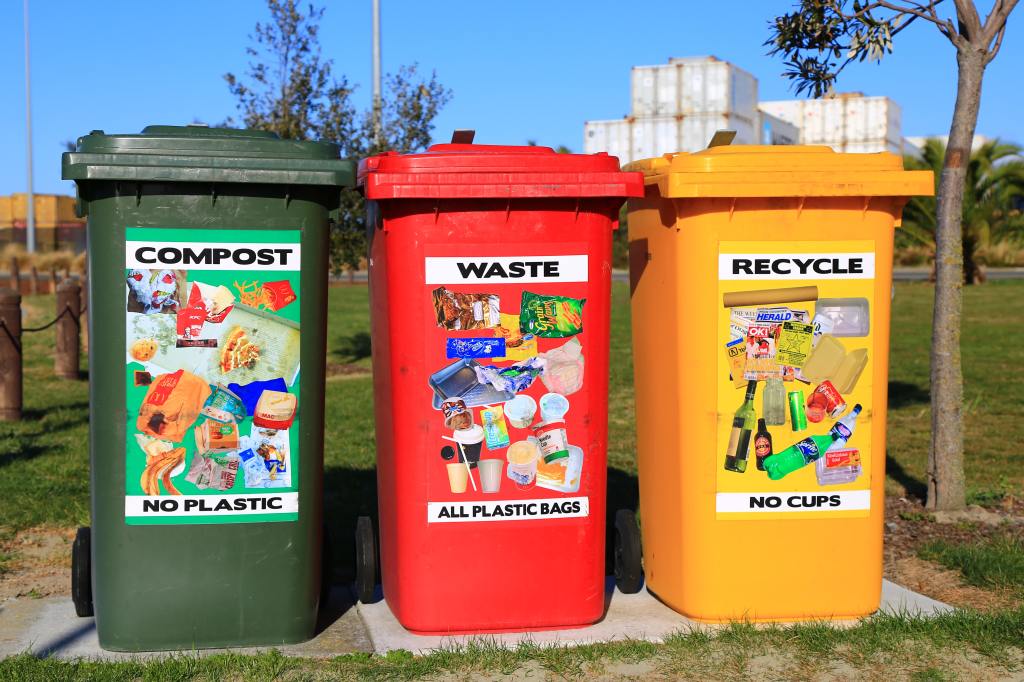
    Confusion reigns over what goes in the bin.

    Click here if you’re new to this blog and want to know what it’s all about.

    Basic Rules to Live by When Recycling

    Let’s look at some basic rules that apply to recycling these days. Avoiding these mistakes can and will make a difference in your recycling efforts.

    • Wash all recyclables. Food contamination is one of the biggest obstacles to our waste actually getting recycled.
    • No greasy food containers – Grease can cause problems when it lands in recycling. Greasy pizza boxes are a common culprit of this. If there is a lot of grease on your pizza box it’s best to throw it out. Often you can tear off the lid for recycling if it’s not greasy.
    • Plastics – #1 and #2 plastics have the best chance of being recycled in our curbside bins. Almost every recycler on the planet takes them. We need to focus on reducing the use of the other types of plastics that don’t recycle.
    • Caps on or off? – On the bottle. Most recycling systems use sensors that detect larger objects. A bottle cap that is loose has little chance of being detected and recycled, but if it’s on a plastic bottle it likely will.
    • No soft plastics – I did this post on plastic bags and soft plastics back in February you might find helpful. Bottom line, don’t put plastic bags and wrappers into your recycling. No straws! Think of them as soft(er) plastic.
    • No reusables – Food storage containers made to be reused cannot recycle. Same with dishes that are treated ceramic or glass. Basically, if an item wasn’t made to be disposable it doesn’t go in your recycling bin. Try donating it.
    • No disposable coffee cups – Cups made to hold hot liquids have a plastic coating on them so the paper doesn’t dissolve. These coated cups cannot go into recycling.
    • No batteries – Some recycling services might take rechargeable batteries, but generally, all household batteries go to an e-waste drop-off. Most electronics stores, like Best Buy, have e-waste collection bins and many communities regularly hold collection events. However, fewer places take disposable, as opposed to rechargeables which have more value in recovery. Check out this article I wrote for Earth911 for more on Mail-in Recycling Options: Household & Hearing Aid Batteries.
    • No tissue paper, napkins, or paper towels – Clean or dirty, these paper products are made from a refined paper material that cannot be recycled. No matter how clean it is.
    • Window envelopes are okay – Most recycling services have a washing process that removes the plastic window and the glue. It’s best to check with your service and when in doubt remove the plastic window. It will give the paper a better chance of getting recycled.
    • Mixed materials do not recycle well – When a container has cardboard sides and a metal rim, like some coffee cans, there is a slim chance these materials will get separated and recycled. Check with your service to see what they say you should do with them.

    In general, recycling systems are the same when it comes to these items, but there are always exceptions. I urge you to check the website of your service provider because every recycling system is different and often changes.

    Bookmark and check your recycling service at least once a month.

    I swear the information on my provider’s site changes about once a month. There are a few large companies in the US that provide trash and recycling services and mine is one of them. I got so lost on their site when I first went there, once I found it I bookmarked the page that shows specifically what I can put in my bin. When I struggle with how to recycle certain items my provider’s site is the first place I go.

    When in doubt, throw it out (or reuse it)

    Following these steps can get you started on a path to proper recycling and eventually waste reduction as you begin to realize how little of it can be recycled. The 4Rs post from March 25th on Recycling Done Right gets into more ways you can improve how you recycle.

    Why It’s Important – Rethinking Recycling

    People around the globe have been trying to recycle for decades, but it can be hard to do when processes are constantly changing and systems are all different. Pile on top of that the fact that we have so many different types of disposable materials in our lives now, it feels like a big chore to recycle correctly. 

    If we’re going to build the habits that reduce our impact on the planet, we’re going to have to learn how to manage our waste better. Correctly recycling is just one of the steps, but it should be the last. Reducing and Reusing should come first as we build the mental mindset of waste reduction on our planet. Let’s all work together to stop wasting our resources.

    Ways You Can Make A Difference This Year

    Check out these 52 ways to celebrate our earth and make a difference from Earth Day.org

    Do something fun this spring, sign-up for a  Clean-Up Event. They’re not just for Earth Day! Check the map and search by the dates you have available. Then save the link and look for ongoing ways to help clean up your community. You may find a local organization you want to join and support.

    Do you like surveys and quizzes? Try some of these EarthDay.org quizzes to test your Climate Change knowledge.

    With Much Gratitude

    That’s it for this week. If you like this post, please forward it to every earth-friendly human you know. 

    Drop me a line anytime if you have questions or comments. I love hearing from you.

    If you would like to support this blog post, please visit my support page where you can make a donation. Every little bit helps me to keep this going.

    Thank you for reading these tips and subscribing. Pat yourself on the back for doing your part. Remember, every little bit helps. 

    You got this!

    Jen
    jen.thilman@gmail.com 
    Sign-up to receive these weekly 4Rs posts

    By clicking submit you agree to share your email address with the site owner and Mailchimp to receive marketing, updates, and other emails from the site owner. Use the unsubscribe link in those emails to opt out at any time.

    Processing…
    Success! You're on the list.
    Whoops! There was an error and we couldn't process your subscription. Please reload the page and try again.
    No comments on 4Rs Tips for 5.6.2022 – Basic Recycling Rules That Make a Difference
  • 4Rs Tips for 4.29.2022 – Transform to a Reusable Lifestyle

    April 29, 2022
    sustainability

    4Rs Tips for 4.29.2022 – Let’s Transform to a Reusable Lifestyle

    How a Reusable Mindset Can Save the Planet

    Living in harmony with the earth means stopping the one-way street of our waste and building a reusable mindset. A lot of the responsibility for making this happen falls on companies that make goods and the packaging that goes with them. But people need to do their part to buy the goods that are responsibly made and reuse as much as they can. If we take a serious look at our reusable habits we are likely to get better at it.

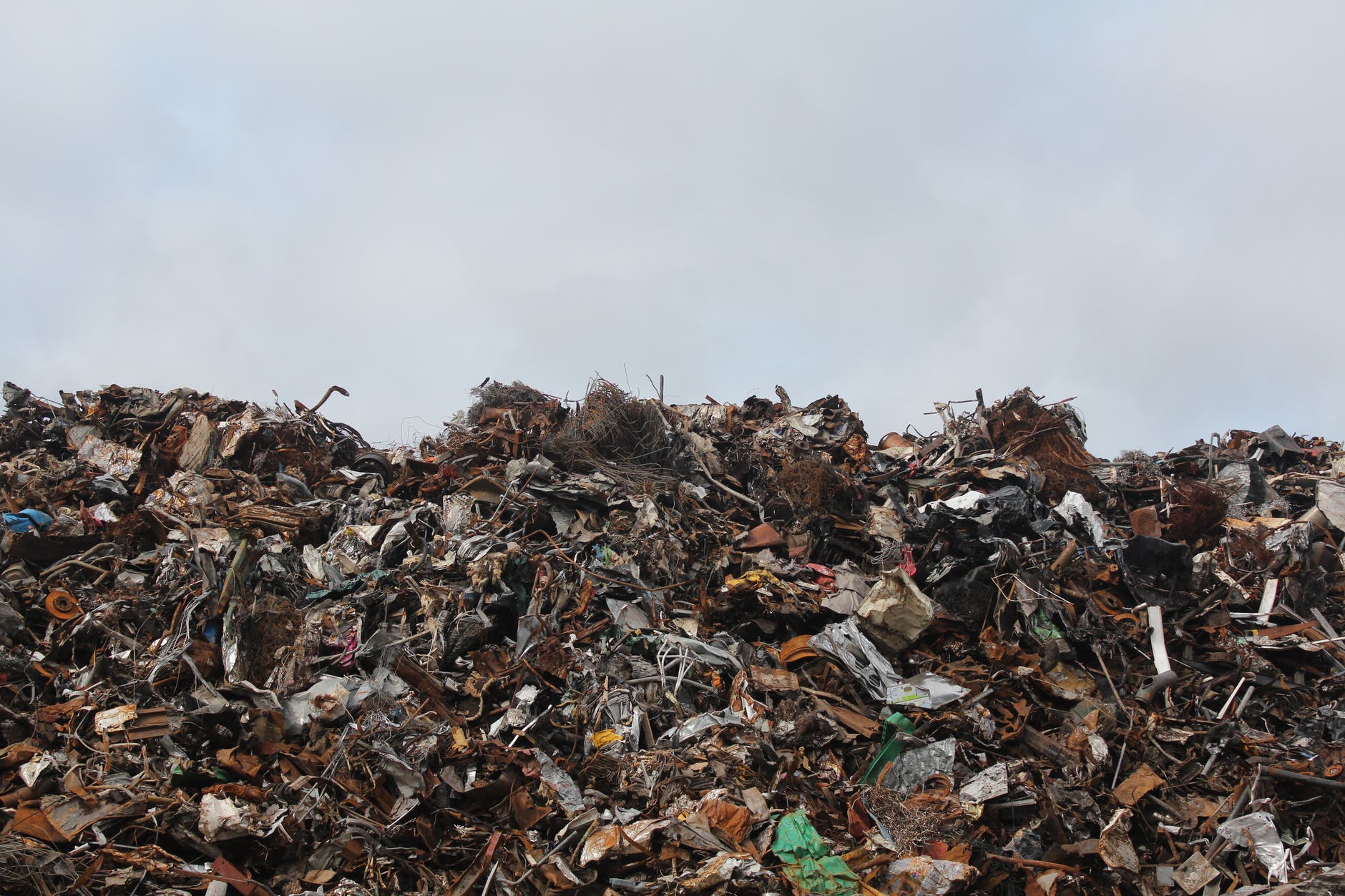
    140 million tons of waste are sent to landfills each year in the US alone. In many countries, people produce nearly 5 pounds of trash per person a day. We have to find ways to reuse it. We need to work on the circularity of our waste.

    People create nearly 5 pounds of garbage PER DAY!

    Photo by Emmet on Pexels.com

    Click here if you’re new to Jen’s blog and want to know what it’s all about.

    What Can We Do To Change the One-Way Direction of Waste

    Thinking about our actions can make all the difference. Here are some simple things we can do in our everyday lives to reuse what we have.

    1. Skip or reduce disposable food storage. Reuse sandwich and zip baggies or buy reusable.
    2. Buy reusable water bottles and beverage containers.
    3. Shop for used products. A great way to eliminate packaging, support circularity, and boost your local economy.
    4. Buy local, non-packaged produce – find and visit your local farmer’s market.
    5. Buy products with less packaging and only buy what you need and will use especially food. 
    6. Buy in bulk the items you use a lot, like toilet paper and canned goods.
    7. Learn composting, a great reuse of organic waste.
    8. Make sure you recycle correctly. If the wrong stuff goes in the bin items are less likely to get recycled in your bin and the bin it gets dump into.

    Reusable food and beverage containers can put a big dent in our waste

    Food storage – I’ve been excited about reusable zip bags for food storage since I saw them at a friend’s house. I haven’t bought any yet because I’ve been reusing the disposable ones I purchased about a year ago. Most times I use them they are clean enough to be washed, dried, and shoved back into the box they came in for the next time. Only when they get really messy do I throw them out.

    Here are some places to buy reusable food storage bags and containers:

    • Russbe is the brand I first saw in action. The company makes waste-free lunch and food storage containers.
    • Grove Collaborative sells planet-friendly products, including reusable bags in a variety of sizes and food storage containers.
    • Stasher Bag offers both reusable bags and containers, and they donate 1% for the planet.
    • Vejibags from Food52 are a great way to store produce and keep it fresh. You can also use them for shopping and skip the plastic produce bags.

    Reusable beverage containers – There are two types of beverages we tend to drink on the go that can create a lot of waste, coffee/tea to-go cups, and water bottles. It’s not hard to reduce our use of disposable containers that often contain these beverages. Here are some ways to do that.

    • Get your own hot cup for your morning caffeine – there are so many cool types I’m not going to try and list any. You can buy them online or at your favorite coffee shop.
    • Get a reusable water bottle. The healthiest water you can drink is filtered to remove chemicals and other contaminants. Bottled water doesn’t always provide that. You can get filtered water delivered, or buy something like a Brita pitcher for your refrigerator. If you have a frig with water and ice built into the door, make sure you change the water filter regularly.

    Shop used goods and buy locally to reduce your impact and support your local economy

    • Buying from local businesses is always better for the economy. It contributes to saving the planet and improves your community.
    • Buying used items from a neighbor’s yard sale or local thrift store eliminates packaging, and supports your local economy, and many stores like Goodwill support people who are struggling, disabled, or down on their luck.

    Save money and the planet with eco-friendly food buying habits

    Only buy what you know you will eat before it goes bad. This can be challenging, especially if you’re single and can’t always buy small quantities. Some tricks to not wasting food are:

    • Shop your local farmer’s market whenever you can. Local farmers often grow organically, are happy to let you use your own bag or container, and work with you on quantities. You also avoid excess emissions from transporting your food to a grocery store, often from far away.
    • Buy non-packaged produce where you can usually choose the quantity and size you want.
    • Store produce in containers that keep it fresh. Reusable cotton bags, like Vejibags from Food52, can keep your veggies fresh and crisp longer.
    • Buy in bulk items you eat or use a lot. This reduces your packaging footprint.

    Composting will make a huge difference to our planet

    Nearly 30% of waste in landfills is organic. This is mostly food waste which emits methane, a greenhouse gas, as food decomposes in landfills. 

    Composting can be a lot easier nowadays, depending on where you live. I live in an apartment so it’s not something I could easily do. But if you are able to, check out these online resources to learn how. If you are able and willing to learn how to start composting, check out this handy guide from NRDC – Composting 101.

    Follow your recycling rules so your waste has a better chance of getting reused

    Make sure you know what does and does not go in your recycling bin. Check your local government or service provider’s website. Follow the basic rules of recycling.

    • No plastic bags or small plastics, like loose caps – put that cap back on the container.
    • No food waste on anything you put in your bin – it will cause everything in your bin to be sent to a landfill.
    • Know for sure what plastics your service takes and throw out or reuse the rest.

    These are just a few of the tips you can learn in this article from EarthDay.org – END PLASTIC POLLUTION:  7 TIPS TO RECYCLE BETTER

    Practice a zero-waste mindset in everything you do

    It could make a big difference. I like getting the Going Zero Waste newsletters that always have great tips. I find there is always more to learn.

    Check out this The Ultimate Sustainable Shopping Guide: How To Find Eco-Friendly Products from Zulily.com. There are so many great tips and resources online.

    Why It’s Important

    You’re smart. You’re reading this blog, after all. So I honestly don’t think I need to explain to you why we need to stop filling the earth with our waste. 

    What I think is really cool is that humans have the ability to fix this. It’s not something that’s up for debate. There are those that will say climate change is natural; the climate will always be changing. But there is no logical explanation for filling the earth, our source of life, with chemicals and damaging waste that harms the planet and all living things on it, including humans. It doesn’t matter if someone doesn’t believe in global warming, our one-way system of waste is illogical.

    Ways You Can Make A Difference This Year

    Check out these 52 ways to celebrate our earth and make a difference from Earth Day.org

    Do something fun this spring, sign-up for a  Clean-Up Event. They’re not just for Earth Day! Check the map and search by the dates you have available. Then save the link and look for ongoing ways to help clean up your community. You may find a local organization you want to join and support.

    With Much Gratitude

    That’s it for this week. If you like this post, please forward it to every earth-friendly human you know. 

    Drop me a line anytime if you have questions or comments. I love hearing from you.

    I do not get paid to write this blog, none of the products I recommend sponsor me, so any support you can send my way would help, even a few bucks.

    Thank you for reading these tips and subscribing. Pat yourself on the back for doing your part. Remember, every little bit helps. 

    You got this!

    Jen
    jen.thilman@gmail.com 
    Sign-up to receive these weekly 4Rs posts

    By clicking submit you agree to share your email address with the site owner and Mailchimp to receive marketing, updates, and other emails from the site owner. Use the unsubscribe link in those emails to opt out at any time.

    Processing…
    Success! You're on the list.
    Whoops! There was an error and we couldn't process your subscription. Please reload the page and try again.
    No comments on 4Rs Tips for 4.29.2022 – Transform to a Reusable Lifestyle
  • 4Rs Tips for 4.22.2022 – Environmental Impact of Our Clothes

    April 23, 2022
    sustainability

    How to Reduce the Environmental Impact of Our Clothes

    Spring is here and many of us find the urge to get rid of old stuff. Old textiles like clothing are common purge items this time of year. How we dispose of them is really important to our planet.

    With 85% of textiles, including clothes, ending up in landfills it’s not only important how we get rid of them but equally important how we buy them. How we buy clothes and dispose of them has a significant impact on the environment.

    There are a lot of wasted materials we could make use of

    Click here if you’re new to Jen’s blog and want to know what it’s all about.

    Let’s Look Differently at Clothes and How We Buy Them

    Try these tips to reduce your impact on the planet from the clothes you wear.

    • Buy what you’ll wear. 
      • Before you spend your money ask yourself, “Do I like this enough I’m going to wear it for a while?” Do this with anything you buy. It will help reduce waste. Or, consider shopping used first. Here’s a link to find a thrift store near you.
    • Buy durable clothes that last. Look up reviews before you buy a certain brand so you know what you’re getting and how long it will last. 
    • Avoid fast fashion that is not made to last.
    • Wash clothes less, especially synthetic materials like polyesters. These mostly come from plastics. When washed these fabrics break down and leach microplastics into our water system. You don’t need to wash a garment every time you wear it. If it doesn’t stink or have stains, why wash it?
    • Buy from brands that have recycling programs and will take back their products to repurpose or recycle them when you’re done with them (see the list below).
    • Shop for clothes made with recycled materials (see the list below)

    A number of clothing manufacturers are taking environmental responsibility for their products. Some offer take-back programs and recapture garments to refurbish them for resale or recycle the materials to make new apparel. 

    Two things to look for when researching a clothing brand are:

    1. Do they take back their products to recondition or recycle the materials?
    2. Do they use recycled content for making new apparel?

    Shop These Brands That Are Doing Their Part to Make Our Clothes Sustainable

    Here are some brands that are doing their part to support an environmentally friendly circular economy:

    • BATOKO – this UK company makes recycled plastic swimwear
    • Eileen Fisher – offers a Renew program selling their gently used apparel and they take back their products when you’re done wearing them.
    • KOTN – makes sustainable apparel from certified organic cotton
    • Levi’s – offers a Second Hand online store where you can get vintage jeans and trucker jackets
    • pact – making sustainable organic apparel. Offers a recycling program for any old clothes
    • Patagonia – check out their Worn Wear page. They offer a trade-in program and use recycled materials to make their apparel.
    • Rapanui Clothing – makes circular organic apparel that they take back, take apart, and reuse the materials to make new garments.
    • Reef and Ledge – outdoor apparel made from recycled and sustainable materials
    • Wolven – makes their apparel using recycled plastic bottles

    Use the internet to research how sustainable a brand is or search for lists of responsible apparel companies. Like this one from Going Zero Waste that gives us 50 Ethical and Sustainable Clothing Brands.

    Find Sustainably Certified Clothing

    Here are a few organizations that certify manufacturers for sustainability. Search by brand name to see how your favorite clothing makers stack up.

    • Bluesign® systems partner
    • B-Corp certified: Find a B-Corp
    • OEKO-TEX: Buying Guide
    • Global Organic Textile Standard (GOTS)
    • Fair Trade
    • Worldwide Responsible Accredited Production (WRAP)

    This article from Sustainable Brands is a guide to sustainable shopping for the 2021 Holiday season but continues to be a great resource. Bookmark it for future reference.“WALKING THE TALK – Conscientious Consumption: The SB 2021 Holiday Gift Guide”

    Avoid Fast Fashion

    I’m cheap. I’ve always wanted to find the best deal. When I realized the true cost of buying cheap clothes I started buying used and never looked back. I’m not going to say I don’t buy new – the dress for my daughter’s wedding was new – but it is rare.

    The apparel industry contributes
    10% of global emissions and growing

    Bright Colored Clothes Can Be Bad for The Planet

    It’s hard to think that the color of the new outfit you pick makes a difference to our environment, but it does. For years the dye used to recolor materials has been contaminating our planet when the dye water is disposed of, then again when the clothes end up in a landfill and those chemicals seep into the earth. 

    Buying from companies certified as sustainable means their operations are monitored to ensure they are using only environmentally friendly dyes and chemicals to treat materials.

    How and Where We Shop Makes a Huge Difference

    I’ve mentioned thrift store shopping before, maybe because I’m obsessed with the thought of the really cool deals I’ve found, but I would be remiss if I didn’t mention this resource in a post about clothing. Some of the ways shopping at thrift stores help the environment may not be real obvious.

    Shop IRL

    Shopping local thrift stores In Real Life not only supports a circular economy, but it also:

    • Reduces your impact by eliminating emissions due to shipping, and
    • It supports your local economy and community since most thrift stores are run by charitable organizations.

    When shopping for used goods in-person is not an option, there are online thrift stores available.

    Check Out These Online Thrift Stores

    You’ll probably get tired of hearing me say “shop used,” but it’s one of the best solutions to reducing the environmental impact of the apparel industry. 

    Here are a few online thrift stores and consignment shops where you can shop or sell good condition name brand items you have and don’t want anymore.

    • Poshmark – a marketplace to sell and buy fashion, home decor, and more.
    • threadUP – consignment and thrift store.
    • Vestiaire Collective – buy and sell designer second-hand fashion.

    Check out 10 Places to Shop Secondhand Online, or 50 Ethical and Sustainable Clothing Brands, from Going Zero Waste.

    If we stop buying new and start using what we have by buying used and recycled clothes, we will not only reduce emissions but also landfill waste and toxins going into the planet. A lot of clothing is made from polyester, nylon, and other synthetics, which are made from plastics and fossil fuels.

    Despair of Clothing Donation and Disposal

    It’s frustrating to watch videos showing piles of clothing dumped on villages in underdeveloped countries, the people scurrying to pick out anything they can sell to support their families. I hate seeing this because I donate all my wearable used clothes. But not all donated clothes end up being resold. The ones that aren’t being shipped overseas, are burned, or end up in landfills.

    Only donate good condition clothes

    If the clothes you’re tossing aren’t in good condition they will not likely hit a resale shop or help the charity where you donated them. Don’t despair if they seem too worn for resale, there may be an organization in your community that will pass them on to people in need. Look online to see if that’s an option in your area.

    You may be able to find other uses if the material is too worn.

    Ways to Reuse Old Clothes You Can’t Donate

    There are a number of ways you can reuse the material from old clothes. 

    Crafts and other uses for textiles 

    If you enjoy sewing, cut up worn clothes and save good sections for patching jeans, making doll clothes, chew toys for pets, or making a quilt. Look up crafts you can do with used materials.

    Recover furniture that has worn or torn materials. Even hiring this done can be cheaper than buying new. It’s definitely better for the planet.

    Cleaning rags and napkins

    Old t-shirts make great rags, especially cotton. I keep a rag bag and when I can’t donate an old t-shirt or any other garment, I cut it up and toss it in my rag bag. Use these instead of paper towels to clean or wipe up messes, then toss them in the wash. Use nice pieces of material to make your own napkins, just cut an even square and hem the edges. Voila!

    Why It’s Important

    Buying clothes made with recycled materials will support a transition to a circular economy, which will reduce our demand on the planet and end the one-way street that sends our used materials to landfills.

    The apparel industry:

    • Produces 10% of global emissions
    • Uses enough water to quench the thirst of 5 million people annually
    • Accounts for 20% of wastewater from material treatments and dying
    • Contaminates our water with toxins from those dyes and treatments 
    • Adds to the microplastic on our land and water that comes from synthetic materials, like polyester and nylon.
    The Benefits of Changing How You Buy Clothes
    • Save money
    • Provide jobs in your community
    • Prevent the materials from ending up in landfills and oceans
    • Keep microplastics out of our food and water supply – synthetic materials largely used to make apparel and household textiles (towels, sheets, etc.) are made from plastics and fossil fuels. When they end up in landfills or the ocean they break down into small microparticles in our food and water supply. This is why they are now finding microplastics in human organs.

    If we take this seriously – rethink the way we shop and consume; and support government and businesses to immediately change policies and how goods are made – we may have a chance of reversing temperatures that will make the earth uninhabitable. We may be able to keep our climate at or below 1.5° celsius.

    Ways You Can Make A Difference This Year

    Check out these 52 ways to celebrate our earth and make a difference from Earth Day.org

    Do something fun this spring, sign-up for a  Clean-Up Event. They’re not just for Earth Day! Check the map and search by the dates you have available. Then save the link and look for ongoing ways to help clean up your community. You may find a local organization you want to join and support.

    With Much Gratitude

    That’s it for this week. If you like this post, please forward it to every earth-friendly human you know. 

    Drop me a line anytime if you have questions or comments. I love hearing from you.

    I do not get paid to write this blog, none of the products I recommend sponsor me, so any support you can send my way would help, even a few bucks.

    Thank you for reading these tips and subscribing. Pat yourself on the back for doing your part. Remember, every little bit helps. 

    You got this!

    Jen
    jen.thilman@gmail.com 
    Sign-up to receive these weekly 4Rs posts

    By clicking submit you agree to share your email address with the site owner and Mailchimp to receive marketing, updates, and other emails from the site owner. Use the unsubscribe link in those emails to opt out at any time.

    Processing…
    Success! You're on the list.
    Whoops! There was an error and we couldn't process your subscription. Please reload the page and try again.
    No comments on 4Rs Tips for 4.22.2022 – Environmental Impact of Our Clothes
  • 4Rs Tips for 4.15.2022 – Reduce (the Elephant in the Room)

    April 15, 2022
    sustainability

    4Rs Tips for 4.15.2022 – Reduce (the Elephant in the Room)

    Photo by Pixabay on Pexels.com

    Click here if you’re new to Jen’s blog and want to know what it’s all about.

    We Need To Reduce Our Impact

    It’s not only because we have more people on the planet, it’s how many of us cling to and demand our conveniences. Buying stuff and wanting to get things cheap and easy is a major factor in our climate crisis. There is no denying that.

    I’ve heard people say our environmental problems are caused by big businesses that burn fossil fuels, chop down forests, and contaminate oceans. The reality is they do this to produce stuff for us, the consumers. They do it because we pay them to. This is the elephant in the room we don’t want to talk about or admit. 

    We want deals and we want to buy stuff like fuel, clothing, energy, food, and new tv. The companies we buy from are competing for our money because, well, that’s why they’re in business. They’re rarely required to do that in an earth-friendly way. 

    I’m not saying we shouldn’t buy stuff. I’m saying we need to be aware and responsible about how we buy stuff. 

    It starts with two key steps:

    1. Be aware of our actions – pay attention and track how we buy stuff; and 
    2. Take small steps to change our buying habits and how we do things 

    Reducing waste isn’t only about paying attention to how much you generate in your home, it’s also about the waste caused by companies you buy from.

    Reducing Waste In Our Buying Habits

    More people today are taking a serious look at their stuff. How much we own and buy, and why we buy it. Did we really need it? Could there be a better way? 

    If you’re serious about changing how you do things you might want to check out The Minimalists. They have a great podcast on how to reduce anything, with a recent show on Sustainable Living and building a circular economy that you won’t want to miss.

    Let’s start today by making small changes

    Here are some tips that can help.

    • Shop used – Some of my favorite purchases were from the Goodwill, Salvation Army, or my local thrift store (link to locate one in your area). I buy most of my clothes and books at these places. I often find good-quality clothing that still has a price tag on it. You give up the convenience of having less of a selection and having to shop around a bit, but that is nothing compared to the waste generated from making new, 64% of which ends up in landfills. 
    • Look for the best value – If it doesn’t last very long the cheaper price isn’t the best value. Electronics are a good example. Read reviews and buy a quality product that will last. I remember when my first flat screen died, the customer service person at the company said I was lucky I got five years out of it. Five years! I paid $850 for it. The old tub tv I had before it cost me $350 and lasted 20 years! It’s not our fault they make things so disposable, but we can choose to buy the stuff that will last longer.
    • Cut back on fast food – It’s not only bad for your health and waistline, but it’s bad for the health of the planet. From the processing of the food to the disposable containers and utensils, the whole concept of fast food is wasteful and we shouldn’t eat it as much as we do. Try taking your lunch to work and preparing food ahead of time.
    • Buy local and organic – I know I’ve said this before, but the healthiest thing we can do for ourselves and the planet is to buy organic produce from local growers. I see small farmers stepping up to go organic but they need our support. Organic means no chemicals damage the earth in the growing of your food. Local means transportation emissions are at a minimum.

    Set aside time to prepare meals and shop responsibly. When you rush you’re more likely to make poor decisions, like grabbing fast food or impulse buying the latest smartphone or electronic toy that may not last very long.

    • Avoid vampire power – How often do you leave a phone charger plugged into the wall or USB port? You would be surprised how much energy this can waste. Make it a habit to unplug the entire charge unit when grabbing your phone. It makes a difference and is a simple habit to build. Some electronics are made to sit idle in ready mode for you to turn them on. This causes them to waste energy. TVs, computers, stereos, printers, and video games are some common culprits. Unplugging them or turning them off at a powerstrip can save as much as 10% on your home energy bill. And don’t leave things on a charger when they’re fully charged. This wears out your battery and wastes energy.

    Sustainable Shopping Resources

    If you shop online and want to live planet-friendly, you probably feel the conflict I do when I place an order. Could I have found that for the same price at a store near me? Is the cost actually higher due to the emissions in added shipping? But wait. It had to ship from somewhere to the store you bought it from, right? 

    It feels like we can rationalize our online purchases, but the best way to feel good about them is to buy from a store that is going out of its way to reduce emissions, packaging waste, and damaging chemicals. You need a store where all the items they sell were made sustainably. Where the company and their suppliers are carbon neutral – meaning they take measures to offset and be transparent about how they reduce their carbon footprint. Here are a few online companies to check out.

    Home and Personal Care Items

    Look into Farm Fresh to You organic produce boxes. They may ship to your zip code.

    Brightly – Is climate-neutral certified and offers a variety of products. From clothing and kitchen needs to personal care items and sustainably fun products for the whole family.

    Green Eco Dream – Sell kitchen and personal care products. They have a subscription service to save you time when buying your favorite eco-friendly products.

    Outdoor Gear, Clothing, and Apparel

    Patagonia – Is mostly known for its sporting gear and apparel, and now offers Patagonia Provisions. Food for home or outdoor adventures like camping. They sell reusable beverage containers, as well as sustainable beer and wine. Patagonia is the force behind the 1% for the planet program where member companies donate one percent of their sales to healing the planet. One of the most sustainable brands out there, I recommend buying from them and learning how they do business so you know what to look for in a sustainable company.

    Tools to help you reduce your impact

    The Goodside app tracks your progress toward sustainability. It helps you estimate your carbon footprint and find ways to do better.

    Don’t Forget Earth Day

    Earth Day is next week. Here are some events you can participate in that will make a difference. On April 22nd or any day of the year. 

    Here are some more things you can do for Earth Day:
    Check out Find Earth Day Events in Your Area from Mother Earth News. You might find something you enjoy doing and you’ll feel good about helping the planet.

    Plant a tree and other community events – look online to find an Earth Day event in your community. I know in my city Tree Fresno has a tree planting scheduled where anyone can volunteer to go help plant trees. What a fun way to do your part.

    Check out the One Earth Film Festival. Based in Chicago, IL, US, they also have online viewing available.

    With Much Gratitude

    That’s it for this week. If you like this post, please forward it to every earth-friendly human you know. 

    Drop me a line anytime if you have questions or comments. I love hearing from you.

    I do not get paid to write this blog, none of the products I recommend sponsor me, so any support you can send my way would help, even a few bucks.

    Thank you for reading these tips and subscribing. Pat yourself on the back for doing your part. Remember, every little bit helps. 

    You got this!

    Jen
    jen.thilman@gmail.com 
    Sign-up to receive these weekly 4Rs posts

    u003cemu003eBy clicking submit you agree to share your email address with the site owner and Mailchimp to receive marketing, updates, and other emails from the site owner. Use the unsubscribe link in those emails to opt-out at any time.u003c/emu003e

    Processing…
    Success! You're on the list.
    Whoops! There was an error and we couldn't process your subscription. Please reload the page and try again.
    1 comment on 4Rs Tips for 4.15.2022 – Reduce (the Elephant in the Room)
  • 4Rs Tip for 4.8.2022 – How to Fight Climate Overwhelm

    April 8, 2022
    sustainability

    4Rs Tip for 4.8.2022 – How to Fight Climate Overwhelm

    Click here if you’re new to Jen’s blog and want to know what it’s all about.

    Pick Your Battles and Take Control

    An article in Psychology Today said that “more and more people are grappling with moderate to severe climate anxiety.” This isn’t surprising since it has really snowballed on us. What I mean is the problem has been building so there’s a lot of work piled up.

    Photo by Markus Spiske on Pexels.com

    When it comes to climate change it’s easy to get overwhelmed. The best approach is to pitch in by finding things you enjoy doing. I enjoy writing the 4Rs blog for two reasons. 

    • It motivates me to stay current with what needs to be done so I’m thinking about how I can help, and
    • It makes me focus on boiling action into easier steps we can all take, no matter how much time we have.

    When I break it down into actionable items, it’s easier for me to figure out what I can do.

    Like anything, once you start taking action it feels like a task is more doable. Climate action is no different. If all you can spare is 15-30 minutes a week (a day would be great – I’m just sayin’), take a few of those minutes right now and look through these categories of things you can do to help save the planet.

    The more control we have the less anxiety we will feel

    Like anything, once you start taking action it feels like a task is more doable. Climate action is no different. If all you can spare is 15-30 minutes a week (a day would be great – I’m just sayin’), take a few of those minutes right now and look through these things you can do to help save the planet.

    From the comfort of your home…

    Read and stay informed

    15 minutes of reading the website of an organization making an impact can help you find ways to stay informed and take action. Put in a little time researching a few. Here are some I follow for climate news and actions I can take.

    • The Climate reality project has great updates on the reality of our situation and ways to get involved.
    • EcoWatch is a source for the latest eco-news.
    • EarthDay.org can be very educational and a great way to learn what you can do, especially right now during earth month.
    • WasteDive is how I keep up on the latest news on how we are tackling our waste issues across the US.
    • Earth911 is a great resource. It’s my go-to when I need to figure out how to recycle something (I recently started writing for this site). From green investing and how to recycle stuff to gardening and natural living, the newsletter covers a lot of great topics and I like to catch their podcasts when I can.
    • The Natural Resources Defense Council (NRDC) is an environmental agency that has been around since the 1970s. 

    Follow young people and their climate organizations

    We all know younger people have a fresh perspective on things that can make all the difference. There’s a lot of work being done by the youth of our world. Do a little research on youth climate activists and follow a few.

    • The Sunrise Movement is one of my favorites. They’re checking all the boxes for me and what I support.
    • ClimateGeneration.org is a place to find out about events and youth environmental activists.
    • Follow youth activists like Greta Thunberg in the news and on social media. It’s a great way to learn about actions you can take and issues to support.

    Sign Petitions

    Once you find organizations you want to support, sign up for their newsletters and you will likely receive invitations to sign petitions they generate and support. This is a great way to make changes in policies to protect our planet. I’ve found that reading their petitions helps me decide if I support what they do.

    The Climate Reality Project is a good example. The information I find there is consistent with my vetted sources and they send out petitions that I can stand behind, such as this one demanding more transparency from businesses about their environmental impacts on the planet. I feel people have a right to know the impact of a company before they buy from them.
    Note: I recommend that you verify what you read online. Check multiple sources. Look at articles and reports to make sure they’re quoted correctly. The latest IPCC Report is a good example. The report is a public record issued by the United Nations Intergovernmental Panel on Climate Change. Any references to it can be verified.

    In Your Community…

    Volunteer for clean-up, recycling, and zero-waste events

    Clean-up events go on regularly in many communities and there are a bunch of ways to find them. Once I found out about volunteer trash pick-ups in my city I started building the habit of signing up for one a month. Two hours a month isn’t hard to fit into my busy schedule. I may not always make it but it’s always on my radar for next month.

    • Use VolunteerCleanup.org to search for clean-up events by US zip codes.
    • EarthDay.org has this map to help you find current clean-ups in your area.
    • Globally there is World Clean-up Month every year in September. Find or lead a clean-up event in your community.
    • One Earth Film Festival has a take action page to help you find ways to support cleaning up the planet.
    • Search for clean-up events and add your town or city to the search. You never know what you might find. It could be fun.

    Stay informed and vote locally

    Local elections make the most impact on your community and life. Grassroots efforts for climate change often rewrite policies in communities and affect bigger policies.

    If you don’t already know, search online for who your local state and federal representatives are. Then search for their name and their climate record. There are a few sites that rate politicians and how they voted in the past on climate issues. They’re your voice in government, make sure they speak for you. When local candidates come up for election, search on their climate record and make sure they are on the side of the planet.

    Find A Cause and You’ll Find An Organization Fighting For It

    Whether you want to donate to an organization fighting climate change, get involved in activities to clean up our planet, or find out how you can reduce your carbon footprint, there is an organization that can help you learn how to do these things.

    Learn more and take action about…

    Oceans – they’re pretty important. Here are a few organizations you might want to follow:

    • The Ocean Conservancy is finding ways to help our oceans heal and combat the effects of climate change
    • Big Blue Ocean Clean-up has opportunities to volunteer and is in a fight to clean-up our oceans.

    Forests – one of the most important things we need to do is save our forests. They keep us alive by providing the air we breathe. Yet they are under threat with a million acres cut down every year.

    • The Forest Service of the US Department of Agriculture has information on climate change and a helpful list of basic actions we should all be taking.
    • The Rainforest Alliance is a non-profit working to save our forests and helping people and farmers adapt to the changing climate. One way is by teaching regenerative agriculture.
    • The Rainforest Action Network (RAN) is fighting to save our rainforests, one of the most critical elements in the delicate balance of our ecosystem.

    Animals and habitats

    All living creatures have a place in the balance of life. We need to stay aware of what threatens them and fight to save them in any way we can.

    • The World Wide Fund For Nature has been fighting to save our wildlife and their homes for years. They have a great article on forests and climate change you should check out.

    Encourage others to take action

    • Talk to friends and family and ask them if they have suggestions of ways to live eco-friendly and fight climate change. 
    • At work talk to the bosses and ask if they will support the SME Climate Hub initiative to help businesses be more sustainable.

    We will feel less anxious about climate disasters if we are prepared. Learn about efforts to help us be more resilient to changing climate and severe weather. Check out this US Climate Resilience Toolkit.

    Find something that interests you and commit to following through on it. That’s all it takes.

    Don’t Forget Earth Day

    • Earth Day is April 22nd. Don’t forget to grab your free tool kit and help make a difference in the life of our planet and how we can live in harmony with it.

    Why It’s Important

    I’m not going to sit here and repeat the statistics. I don’t want to increase anyone’s anxiety, including mine. The fact that scientists are predicting another busy hurricane season is enough to freak me out.

    Bottom line, it’s time we all got off our duffs and took action. According to the latest IPCC report, this is the last decade to make the changes needed before it’s too late.

    With Much Gratitude

    That’s it for this week. If you like this post, please forward it to every earth-friendly human you know. 

    Drop me a line anytime if you have questions or comments. I love hearing from you.

    I do not get paid to write this blog, none of the products I recommend sponsor me, so any support you can send my way would help, even a few bucks.

    Thank you for reading these tips and subscribing. Pat yourself on the back for doing your part. Remember, every little bit helps. 

    You got this!

    Jen
    jen.thilman@gmail.com 
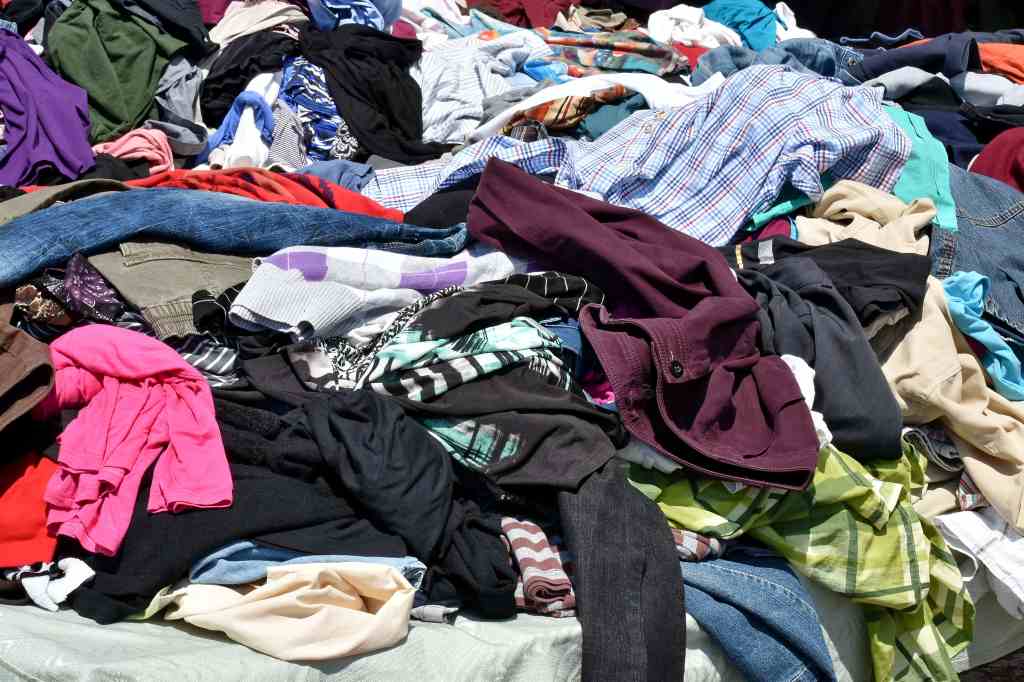
    Sign-up to receive these weekly 4Rs posts

    u003cemu003eBy clicking submit you agree to share your email address with the site owner and Mailchimp to receive marketing, updates, and other emails from the site owner. Use the unsubscribe link in those emails to opt-out at any time.u003c/emu003e

    Processing…
    Success! You're on the list.
    Whoops! There was an error and we couldn't process your subscription. Please reload the page and try again.
    1 comment on 4Rs Tip for 4.8.2022 – How to Fight Climate Overwhelm
  • 4Rs Tip for 4.1.2022 – Welcome to Earth Month

    April 1, 2022
    sustainability

    Click here if you’re new to Jen’s blog and want to know what it’s all about.

    “The sky is falling!”
    April fools!

    The sky may not be falling, but we know it’s getting worse. Our air isn’t clear. Our earth isn’t clean. I recently moved to a city with the second-worst air quality in the US. I’m still not used to the black dust on my kitchen counters. Where I live, it feels like the sky is falling.

    Photo by eberhard grossgasteiger on Pexels.com

    Many of us want to do something to help our environment heal, but getting out to march in the streets for change isn’t always feasible. For those of us who are disabled, it’s not always doable. The one thing we all can do is change how we act in our homes.

    A lot of environmental problems come from our waste habits. Habits of convenience. It’s more convenient to…

    • order meals and groceries delivered,
    • buy pre-packaged foods that are quick to prepare,
    • use paper and plastic dishes even when we eat at home,
    • drive-thru to pick up a meal when we’re too tired to cook, or
    • forget how much waste we generate after we’ve put it on the curb.

    We all do these things. We have succumbed to the conveniences of our modern world. Waste has become too…well, convenient. 

    It takes effort to change and move away from wasteful habits. It took years for these conveniences to grow on us. It’ll take time to make the changes we know we need to make.

    Let’s start building earth-friendly habits today!

    I heard something recently that helps me look at change differently – take complex challenges and make them bite-sized. 

    I have one overarching goal – to save the planet. Now, I’m not going to sit here and try and tell you that I can do that on my own. Because I can’t. What I can do is choose not to sit back and say Oh well, there’s nothing I can do about it. I tackle it in small bites, like tracking my waste and how much I eat out.

    Bite-sized habits are a lot easier to obtain

    We need to take our big goals and figure out the obtainable baby steps, or little goals, we can focus on to get there. Here are some bite-sized tips that may help.

    • Write a meal plan at the beginning of each week.
      • Schedule time for meal planning and grocery shopping. It’s easier to get it done right when you set aside time and aren’t as rushed.
      • Take food out of the freezer when you need it to thaw for a planned meal.
      • Wash reusable containers so they’re ready to carry lunches for the week.
    • Use these mini-goals to remind you to take reusable bags when you go shopping.
      • Put reusable bags on your shopping list.
      • Slap a reminder note on or near your door so you see it on your way out.
      • Stick a note on your dash so you don’t leave your reusable bags in the car.
    • Use a wall calendar (or your phone) to jot down when you eat fast food or carry out.
      • At the end of the week look how often you did it and make it a goal to do it one less time next week.
      • Keep working on it until eating out is a treat and not the norm.
    • Stop using paper towels and napkins. Pick up cloth napkins at a thrift store.

    Have a hard time remembering to do these things? Put it on your calendar or on your phone so it goes off to remind you.

    Are the products you buy earth-friendly?

    Humans are creatures of habit. We like what we are comfortable with, so we often pull the same brand off the shelf without thinking about it. 

    Do you have a favorite brand you always buy? Do a bit of research to find out how earth-friendly it is. Making a change can feel like a sacrifice, but it’s a small one when we look at the consequences of not using recycled and eco-friendly products. 

    • Schedule time once a week to look at the brands you buy. Are they eco-friendly?
      • In your search engine put, Is brand / product made sustainably?
      • Use Ecosia to search, they plant a tree when you do.
      • Earth911 has this guide to finding sustainable toilet paper
      • On LiveKindly you can search for articles on how to buy sustainably, and check out their tools for earth month for more great tips.
    • EarthHero makes it easy to find products that are sourcing materials responsibly.

    Don’t try and do this all. Find what works for you and take it one step at a time. I’ve found Atomic Habits, by James Clear, extremely helpful with this approach. Currently, you can sign up for his free newsletter. It’s helping me to break bad habits and build good ones.

    Don’t Forget The Earth

    • EarthDay.org gives us these tool kits to help us make changes and take actions that can make an ongoing difference.
    • Check out Going Zero Waste by Kathryn Kellogg. I subscribe to her newsletters and find them helpful and inspirational. Here’s a recent one that is full of great ideas, 18 Ways to Celebrate Earth Day at Home.

    Why It’s Important

    We need to let companies we buy products from know that we don’t want them damaging our planet. If we buy eco-friendly products, manufacturers will be forced to change to meet consumer demand. That’s the way it works.

    If we stop using plastic shopping bags, they’ll stop being made. If we only buy eco-friendly products, more of them will be made. But currently, the most damaging products to our environment are the top-selling brands in the US.

    Paper products are a good example. Some of the top-selling brands of toilet paper and paper towels are made with virgin wood. While other companies have found ways to make them sustainably. Cutting down trees emits carbon into the atmosphere and reduces how much of it our planet absorbs. This is a major contributor to our carbon footprint. With a million acres of the world’s forests being chopped down each year, we need to stop buying these brands. The logging industry creates 2X more emissions than cars and trucks in Canada and the US.

    With Much Gratitude

    That’s it for this week. If you like this post, please forward it to every earth-friendly human you know. 

    Drop me a line anytime if you have questions or comments. I love hearing from you.

    I do not get paid to write this blog, none of the products I recommend sponsor me, so any support you can send my way would help, even a few bucks.

    Thank you for reading these tips and subscribing. Pat yourself on the back for doing your part. Remember, every little bit helps. 

    Don’t fuss if you aren’t always able to do this stuff, keep trying, and don’t give up. 

    You got this!
    All my best, 

    Jen
    jen.thilman@gmail.com 

    Sign-up to receive these weekly 4Rs posts

    u003cemu003eBy clicking submit you agree to share your email address with the site owner and Mailchimp to receive marketing, updates, and other emails from the site owner. Use the unsubscribe link in those emails to opt-out at any time.u003c/emu003e

    Processing…
    Success! You're on the list.
    Whoops! There was an error and we couldn't process your subscription. Please reload the page and try again.
    No comments on 4Rs Tip for 4.1.2022 – Welcome to Earth Month
Previous Page
1 2 3 4
Next Page

Blog at WordPress.com.

Jen Thilman

Writer, Coach, and Planet Lover

  • Home
  • My Writing
  • How I Write
  • About Jen
 

Loading Comments...